Now that Easter is here, hopefully we won’t need to use the heated streets in Holland much longer.
But if you’ve spent even one winter walking downtown, you know exactly why they exist—and why they might be one of the most underrated features of this city.
Because here’s the thing…
They weren’t just built to be a novelty.
They were built out of necessity—and honestly, a bit of fear.
If you rewind back to the late 1980s, downtown Holland had a problem.
Winter.
Not just the cold—but the snow, the ice, the constant maintenance. Sidewalks needed to be shoveled, salted, cleared again—and then cleared again after that. It made downtown harder to walk, harder to enjoy, and harder for businesses to stay busy.
And at the exact same time…
A new shopping mall was being built on the other side of town—what we now know as Westshore Mall.
Fully enclosed.
Climate-controlled.
No snow. No wind. No ice.
For a Michigan winter, that’s a serious advantage.
Downtown needed a response—or it risked losing people.
That’s when someone stepped in with a bold—and honestly, at the time, pretty crazy—idea.
Edgar D. Prince.
Prince wasn’t just a local businessman—he was the founder of Prince Corporation, a major automotive supplier, and a Holland native who cared deeply about the future of the city.
While traveling in Europe, he saw something that stuck with him:
Heated streets.
Not everywhere—but in plazas and public spaces where cities wanted to stay walkable year-round.
And he brought that idea back to Holland. Holland Area Convention & Visitors Bureau
At the time, nothing like this existed in the United States. It was unproven, expensive, and controversial.
But Prince believed in it.
This is the part most people don’t know…
Prince didn’t just pitch the idea and walk away.
He put his own money behind it.
He contributed $250,000 of his own money toward the project, which was roughly a quarter of the total cost at the time.
That kind of commitment helped turn a risky idea into something real.
And it helped rally the city, local businesses, and the Board of Public Works to move forward.
This wasn’t just about comfort.
It was about competition.
At the height of mall culture, downtowns across the country were struggling. Holland made a different choice:
If people were going to choose convenience…
Downtown would become just as convenient.
The heated streets weren’t just about melting snow—they were about keeping downtown alive.
And it worked.
Underneath downtown Holland is a network of pipes that circulate warm water.
That water is heated using waste heat from the city’s power plant, making the system efficient and sustainable.
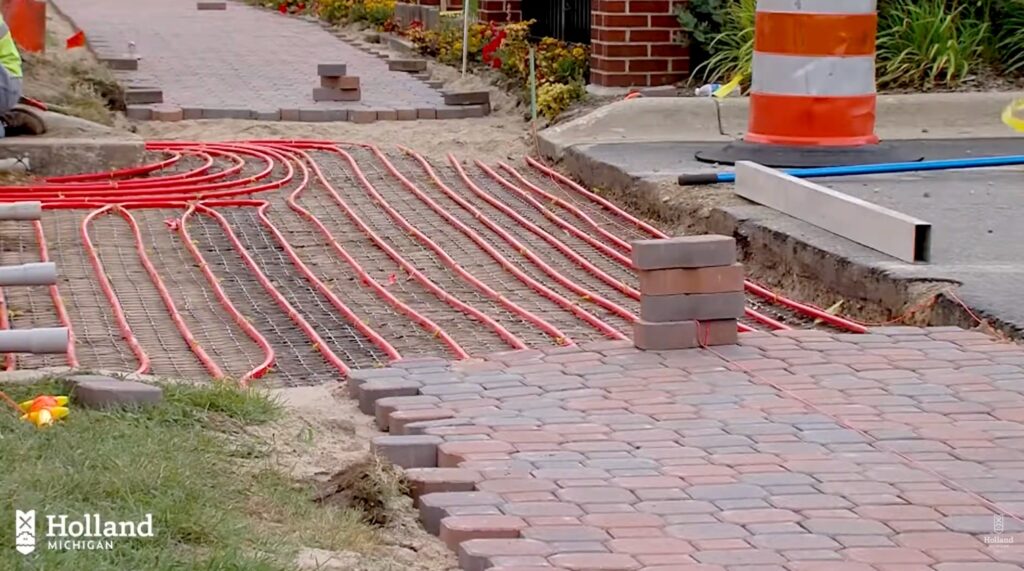
The result?
The system can even melt snow during active storms—keeping downtown walkable when everything else is covered.
What started as an experiment has turned into something massive.
Today, the system covers over a million square feet of heated sidewalks and streets, making it the largest municipally owned snowmelt system in North America. Source 1 Source 2
But that number keeps growing.
Every time the city rebuilds a street or sidewalk, they look for opportunities to expand the system.
Right now, that includes areas like the stretch leading out toward Big Lake Brewing—meaning the footprint is continuing to expand beyond what most published numbers even show.
There are even estimates and local reports suggesting the broader connected system (including private tie-ins) pushes the total footprint closer to or beyond a million square feet when everything is considered together.
At the time, this project was a gamble.
Downtown was torn up during installation. Businesses took a hit. And no one really knew if it would work long-term.
But today?
Holland has the largest municipally-owned snowmelt system in North America.
And more importantly—downtown is still thriving.
This is one of my favorite things to point out on tours. (Book your tour here!)
Because it’s not just a cool feature—it’s a story.
It’s a story about a city that refused to fade when things got hard.
A local business leader who stepped up with a bold idea.
And a community that was willing to take a risk to protect what made it special.
The heated streets aren’t just infrastructure.
They’re the reason you can walk downtown in January…
Grab a drink…
And actually enjoy it.
So now that Easter has arrived, we’re (hopefully) heading into the time of year where the system gets a break.
But give it a few months—and we’ll be grateful for it all over again.
Because in Holland, winter doesn’t win.
We just build around it.